Magna-Tiles Review: The One Toy That Actually Gets Played With for Years
The translucent magnetic tiles that survive the six-week obsession cycle and get used by a two-year-old and a seven-year-old from the same box.
Affiliate disclosure: As an Amazon Associate, Budling earns from qualifying purchases. Some links in this article are affiliate links, which cost you nothing extra.
If you ask a room full of parents to name the toy that earned its money, magnetic tiles come up more than almost anything else. They are the rare toy that survives the six-week obsession cycle, gets played with by a two-year-old and a seven-year-old alike, and does not end up forgotten under the couch by spring. In our house, the Magna-Tiles are the toy I would grab first if I could only keep one, and this is the honest account of why, including whether the name-brand set is worth more than the cheaper alternatives.
Heads up: the link below is an Amazon affiliate link. If you buy through it, Budling earns a small commission at no cost to you. We only recommend toys our own kids actually play with.
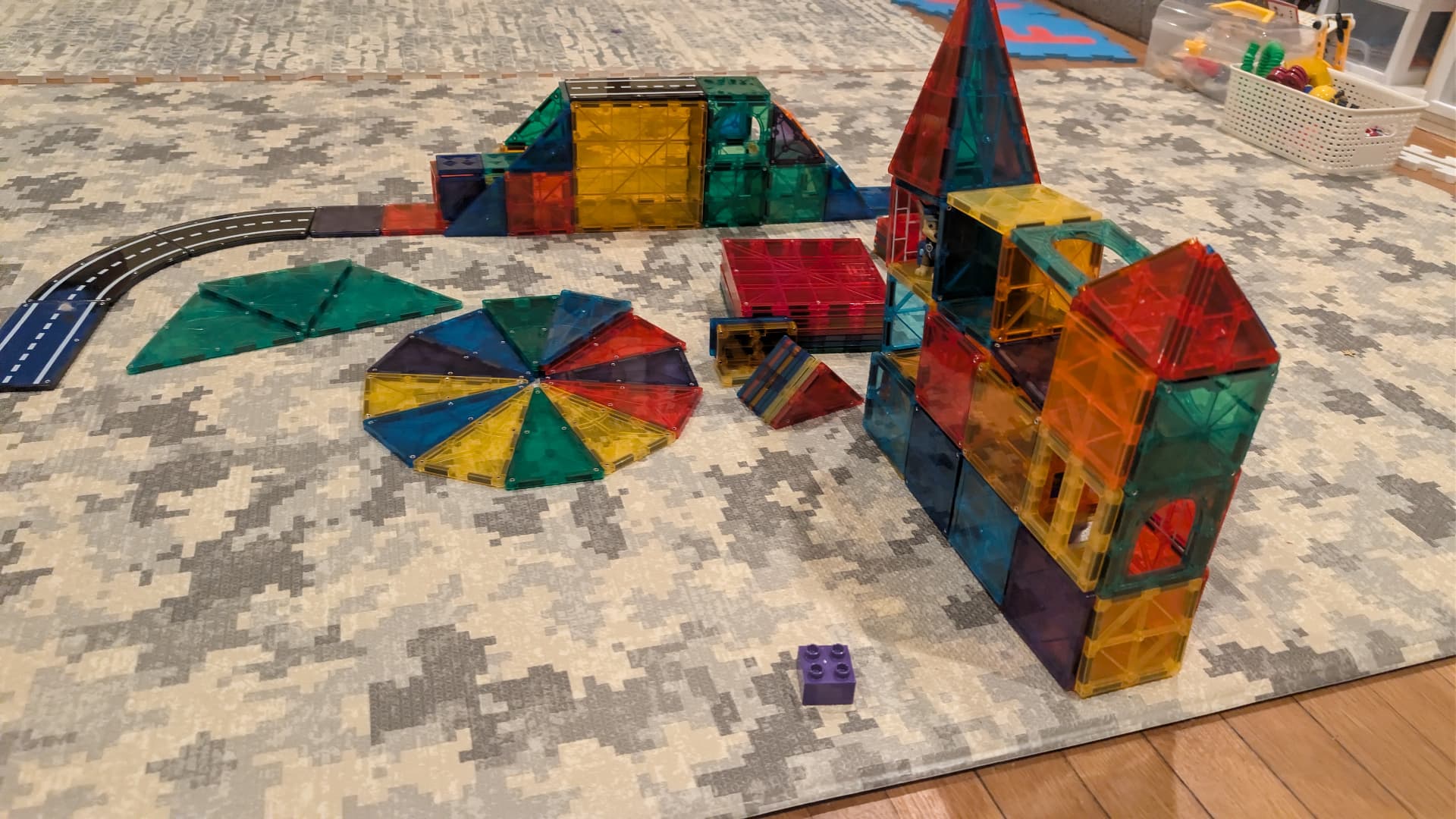
What they are
Magna-Tiles are translucent, magnetic building tiles. Squares and triangles with magnets embedded in every edge snap together to build flat shapes or fold up into three-dimensional structures. The 100-piece Clear Colors set is the classic starter set most people buy, and it is plenty to build something substantial.
The genius of the design is its simplicity. There are no instructions, no right way to play, and no batteries. A toddler snaps two tiles together and is delighted. An older kid builds a multi-story castle, a garage for their cars, a rocket ship, or a marble run. The same box of tiles serves a huge range of ages and skill levels, which is exactly why they last.
Why they are the toy that actually lasts
The single best thing about Magna-Tiles is how open-ended they are, and open-ended is the quality that determines whether a toy survives past the birthday. A toy that does one thing gets boring once the novelty wears off. Magna-Tiles do a thousand things because the kid decides what they do. They are a castle on Monday, a garage on Tuesday, and a trap for the toy dinosaurs on Wednesday.
That range is why they get pulled out for years rather than weeks, and why they work for siblings of very different ages at the same time. A four-year-old and a seven-year-old will build side by side, each at their own level, from the same box. There are not many toys you can say that about.
They also sneak in real learning without the kid noticing. Building three-dimensional structures from flat shapes is genuine spatial reasoning, and the tiles introduce geometry, symmetry, and basic engineering through pure play. Why does the tall tower fall over? The kid figures it out without anyone calling it a lesson.
The real question: original Magna-Tiles or the cheaper knockoffs?
This is what most people actually want to know, because there are a lot of cheaper magnetic tile brands now, often at half the price. Here is the honest breakdown.
The magnets are the difference. The thing you are paying for with genuine Magna-Tiles is stronger, more reliable magnets. Cheaper sets often have weaker magnets, which matters enormously in practice. Weak magnets mean taller builds collapse, tiles do not hold together well, and the kid gets frustrated and gives up. Strong magnets mean ambitious structures actually stand, which is the difference between a toy that gets played with and one that causes tantrums. The original magnets are noticeably stronger and more consistent.
Durability holds up. Genuine Magna-Tiles take years of abuse, dropped, stepped on, thrown in a bin, and keep working. Some cheaper sets crack or the magnets weaken over time. Given how long these get used, the durability matters.
The honest counterpoint: the better cheaper brands have genuinely improved, and if budget is tight, a well-reviewed alternative can be a reasonable entry point. Magna-Tiles are also cross-compatible with many other brands, so a common strategy is to buy one genuine set as the base and supplement with cheaper tiles to bulk up the count. That is a legitimate money-saving move.
But if you are buying one set and want the one least likely to end in frustration, the original magnet strength is the thing that makes it worth the premium. In our experience, the difference is real, not just brand-name markup.
The honest caveats
They are not cheap. The 100-piece set costs meaningfully more than most single toys, and more than the knockoffs. The value is in the years of use, but the upfront price is real.
You will always want more. This is the running joke among Magna-Tiles parents: no matter how many you have, the kid runs out mid-build and wants more. The 100-piece set is a great start, but ambitious builders will eventually want a bigger stash. The upside: they are endlessly expandable, and they make an easy gift for the next birthday.
Small magnets, age rating. They are rated 3+ for a reason. The tiles contain magnets, and the age guidance matters. For under-three, supervise, and check the specific set's guidance.
They spread everywhere. A big magnetic tile session ends with tiles across the whole floor. This is a minor tax on an otherwise great toy, but it is real. A storage bin helps.
Who they are for
Magna-Tiles are close to a universal recommendation for any kid from about three up, and they are one of the few toys genuinely worth the premium price because of how long and how broadly they get used. They are ideal for families with kids of different ages, everyone plays from the same box, for parents who want open-ended, screen-free, battery-free play, and for anyone tired of buying toys that get abandoned in a month.
They are also one of the all-time great gifts, precisely because they are a toy parents are always happy to receive more of, and a set is substantial enough to be a real big gift.
🍬 Grab it here
The 100-piece Clear Colors set we keep coming back to. The classic starter set and the one most families buy first.
- Magna-Tiles Classic 100-Piece Set
Ages 3+. Translucent magnetic tiles with strong, consistent magnets. The starter set that lasts for years.
As an Amazon Associate, Budling earns from qualifying purchases. Prices and availability current at time of writing.
The bottom line
Magna-Tiles are the rare toy that earns the worth it label without an asterisk. They are open-ended enough to get played with for years across a wide range of ages, they build real spatial reasoning through pure play, and the original stronger magnets are a genuine, noticeable upgrade over the cheaper knockoffs. The difference between ambitious builds that stand and towers that collapse into frustration is real. They are pricey and you will always want more, but of all the toys that have passed through our house, these are among the very few I would buy again without hesitating.
They are also a perfect wish-list item: substantial enough to be a real gift, universally loved, and endlessly expandable, so there is always room for the next set. That is exactly the kind of gift a whole family loves to go in on together, which is part of why we built Budling: so the toys kids will actually treasure end up on one list the whole village can chip in on.
Frequently asked questions
What age are Magna-Tiles for?
Most sets are rated 3+. The 100-piece Clear Colors set works well from about three years old through early elementary, and older siblings often play alongside younger ones.
Are Magna-Tiles worth it compared to cheaper magnetic tiles?
In our experience, yes. The original Magna-Tiles have stronger, more consistent magnets and better durability, which means ambitious builds stay standing and the set lasts for years. Cheaper sets can work as a budget entry point or as add-ons to a genuine set.
Do you need more than 100 pieces?
Not at first. The 100-piece set is enough for substantial builds. Most kids eventually want more, so the set is expandable by design, and extra tiles make an easy future gift.
Try Budling free
A group gift registry built for kids. One link, no duplicates, and unspent contributions turn into savings (or 529 deposits).
Create your registry →